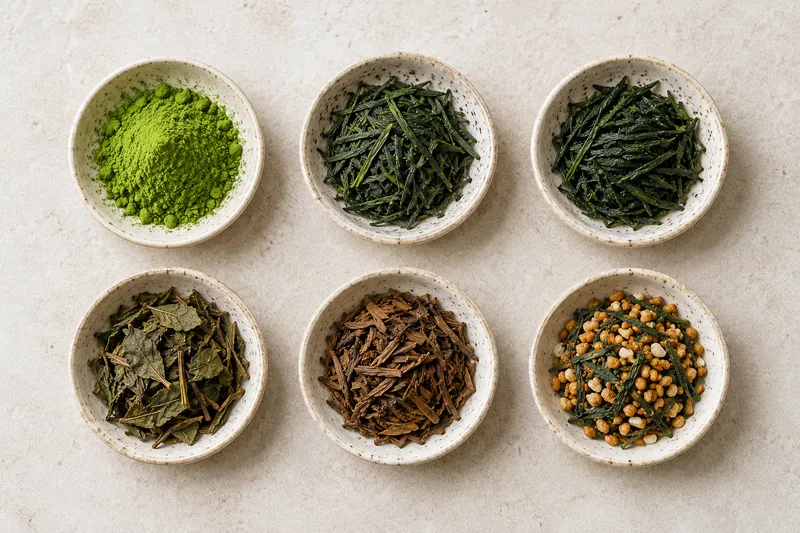
Every Japanese green tea comes from the same plant. What makes them different is whether the bushes grow in sun or shade, whether young or mature leaves are picked, and whether the leaves are then steamed, roasted or ground. Here are the six kinds you'll meet most often.
How Japanese tea differs from Chinese tea
Both countries stop the leaves from oxidising with heat, but Japan uses steam while most Chinese green tea is pan-fired. Japanese tea is therefore a brighter green, with grassy or seaweed-like aromas and a clear umami taste, where Chinese green tea leans toward toasted-nut or floral notes.
The six kinds to know
Sencha (煎茶) — Japan's everyday tea
Grown in full sun, picked young, steamed and rolled into slender dark-green needles. Ippodo calls it the most popular tea in Japan. Fresh and lively, with sweetness, umami and astringency in balance. If you try only one Japanese tea, start here.
Gyokuro (玉露) — shade-grown sencha
Made like sencha, but the bushes are covered for about three weeks before harvest. The leaves turn a deeper green and the taste changes completely: dense umami like dashi broth, with almost no astringency. It's an expensive tea that Japanese drinkers save for special occasions, and it must be brewed with warm, not hot, water.
Matcha (抹茶) — the tea you drink whole
Shade-grown like gyokuro, but instead of being rolled, the leaves are steamed, dried, stripped of stems and stone-ground into powder. You whisk it into hot water and drink the lot, so it's the only tea that is eaten rather than steeped. Read more in Ceremonial vs culinary matcha and How to make matcha at home.
Bancha (番茶) — mature leaves, light taste
Picked from larger leaves than sencha, or from later harvests in the year. Made the same way as sencha but lighter in taste and lower in price. It's the tea Japanese families drink through the day, and the base for hojicha and genmaicha.
Hojicha (ほうじ茶) — roasted tea
Bancha or sencha roasted at high heat until the leaves turn brown. The brew is reddish-brown with a toasty aroma like caramel or nuts, smooth and without astringency or grassiness. People who don't like "green" tastes often come to Japanese tea through hojicha.
Genmaicha (玄米茶) — roasted-rice tea
Bancha or sencha blended with roasted rice, often close to 1:1, sometimes with a few popped white grains. Toasty rice aroma, mild and comforting, and easy to pair with food. The rice makes it one of the most affordable teas.
Comparison table
| Tea | Grown | Form | Taste | Water | Steep |
|---|---|---|---|---|---|
| Sencha | Full sun | Leaf | Fresh, balanced | 70–80°C | 30 s – 1 min |
| Gyokuro | Shaded ~3 weeks | Leaf | Deep umami, sweet | 50–60°C | 2–3 min |
| Matcha | Shaded | Powder | Rich, creamy | 75–80°C | Whisked, not steeped |
| Bancha | Full sun, mature leaf | Leaf | Light, easy | 80–90°C | 30 s |
| Hojicha | Full sun, then roasted | Roasted leaf | Toasty, smooth | 90°C | 30 s |
| Genmaicha | Full sun + roasted rice | Leaf and rice | Toasty rice, mild | 90°C | 30 s |
An easy rule: the greener and more expensive the tea, the cooler the water. Very hot water pulls out bitterness that masks the finer notes, while roasted and rice teas can take boiling water.
Which one to choose
- New to Japanese tea → sencha or genmaicha
- Don't like green, astringent tastes → hojicha
- Already love matcha lattes and want to try it plain → a drinking-grade matcha
- Want to try something special once → a small bag of gyokuro, brewed strictly at the temperature given
Frequently asked questions
Can Japanese green tea be re-steeped?
Yes. Leaf teas (sencha, gyokuro, hojicha, genmaicha) give two or three infusions; use slightly hotter water and a shorter steep for later ones. Matcha is a powder and is drunk in one go.
Why does my tea taste bitter?
The most common causes are water that is too hot or steeping too long. Try dropping the temperature by 10°C first.
We're selecting several kinds of Japanese tea directly at the source. Add us on LINE @095sahzq to hear first when they're ready.
Sources: Ippodo Tea — An introduction to Japanese tea · Yamamotoyama — Brewing instructions & tips